

Loading
The right technology solution begins with understanding what the business is trying to achieve. Our process keeps business goals, users, technical requirements and long-term maintainability connected throughout delivery.

Rather than jumping straight to implementation or forcing pre-packaged tools, we apply disciplined discovery and definition to ensure every architectural decision serves a clear business outcome.
We align engineering decisions with operational realities, user expectations, and future scalability. From multi-tenant SaaS architectures to high-throughput data backbones, our problem-first mindset prevents technical debt and ensures sustainable business value.
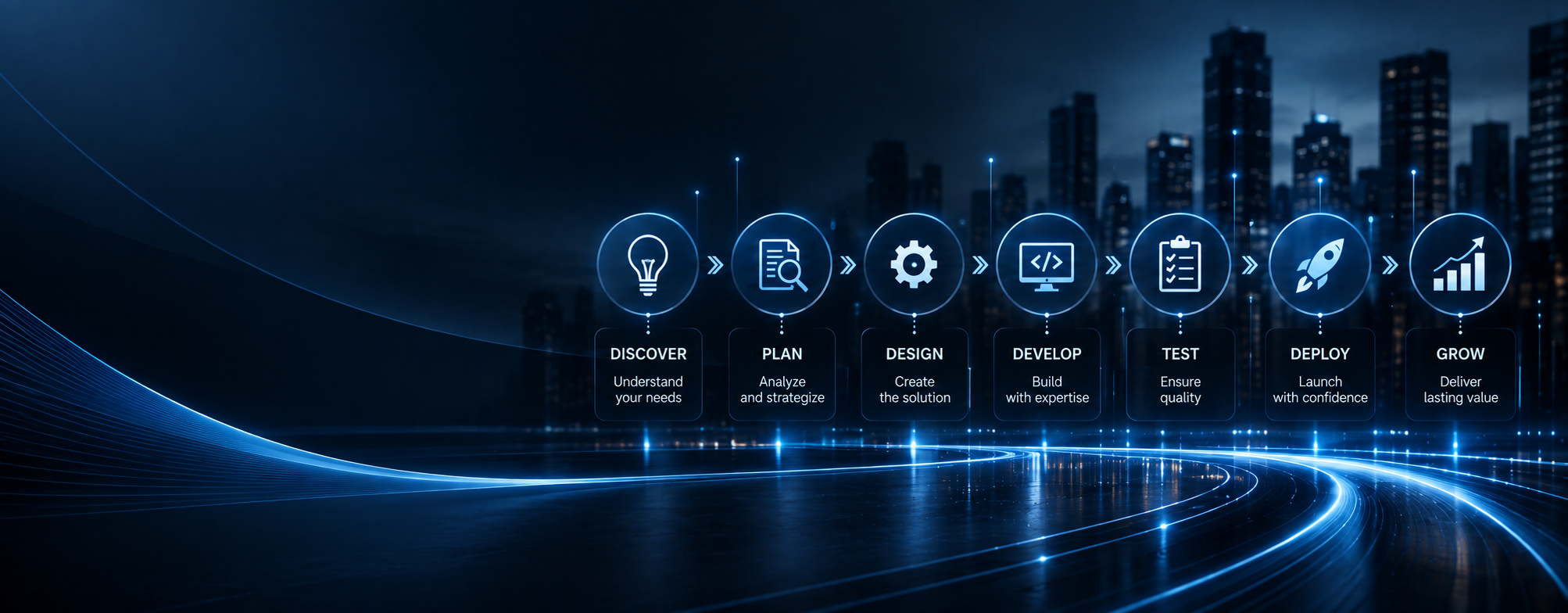
Our structured engineering lifecycle ensures clarity, quality, and momentum across every engagement—from initial discovery through continuous evolution.
Understand business goals, users, workflows, constraints and success criteria, then translate them into clear scope, priorities, architecture direction and a practical roadmap.
Create user journeys, interface concepts, interaction flows and prototypes that validate the experience before full-scale engineering begins.
Build the product across frontend, backend, APIs, cloud, data and security using robust architecture and clean engineering standards.
Apply manual and automated testing, performance checks, security validation and accessibility considerations throughout the development lifecycle.
Release through the appropriate cloud or infrastructure environment with deployment readiness, monitoring, configuration and operational considerations in place.
Maintain, optimize, monitor, scale and extend the product as business requirements, users and technology evolve.
Our delivery model is designed to support international collaboration through structured communication, clear documentation, appropriate collaboration tools and regular progress visibility.
Iterative delivery that allows teams to review progress, gather feedback and adapt as requirements evolve.
Structured collaboration across locations and teams, supported by appropriate cloud-based tools and shared workflows.
Planned time-zone overlap where required to support effective communication, handoffs and coordination across teams.
Clear communication and regular progress reviews provide visibility into delivery status, priorities, decisions and next steps.
Important requirements, decisions, technical context and project knowledge are documented for clarity, continuity and easier collaboration.
Regular checkpoints, progress tracking and shared project information help maintain alignment and identify issues early.
Quality is not a final checkpoint. It is considered throughout the engineering lifecycle across design, code, infrastructure, and deployment.
Readable, standardized codebases engineered for long-term maintainability, refactoring ease, and team scale.
Disciplined test coverage balancing unit, integration, and end-to-end verification within CI/CD pipelines.
Security evaluations, dependency scanning, and defensive best practices embedded across every architecture layer.
Dedicated attention to load times, response latency, query optimizations, caching, and system throughput.
Inclusive user experience design ensuring digital interfaces meet modern accessibility and usability benchmarks.
Clear architecture diagrams, system runbooks, and API documentation supporting knowledge transfer and seamless onboarding.
AI solutions require more than selecting a model. The surrounding data, workflow, application architecture, security, user experience and operational requirements all matter.
Our engineering process brings these considerations together before an AI capability reaches production, ensuring deterministic reliability and enterprise-grade governance.